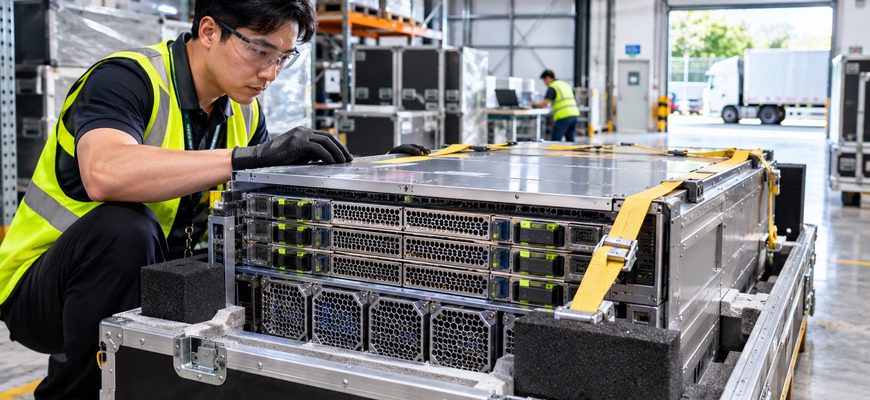
NVIDIA has reportedly instructed its manufacturing partners to pause shipments of AI servers to Malaysia, Singapore, Thailand and Indonesia, according to reports published on November 26, 2026. The move follows new US export controls on advanced semiconductors and could complicate the expansion of GPU computing infrastructure across Southeast Asia.
The Financial Times reported the shipment pause, citing people familiar with the situation, while The Wall Street Journal separately reported instructions to manufacturers. NVIDIA has not publicly confirmed the full scope or duration of the reported halt. On November 27, Singapore’s deputy prime minister said the government was still seeking confirmation and assessing the impact on local businesses.
Reported commercial action and legally effective export restrictions are distinct developments. The exact shipment quantities and pause duration have not been disclosed.
- NVIDIA Server Shipments: What Has Been Reported?
- Why the US Export Rule Changes the Situation
- Important: Brazil Is Not in the Reported Shipment Pause
- Why AI Data Centers Could Face Delays
- What This Means for Chinese AI Companies
- Singapore Says the Reported Pause Is Not Yet Confirmed
- What Happens Next for NVIDIA and AI Infrastructure?
NVIDIA Server Shipments: What Has Been Reported?
According to the Reuters account of the Financial Times report, manufacturers including Dell and Supermicro informed customers that servers containing NVIDIA chips could not be shipped to four Southeast Asian markets.
The Wall Street Journal also reported that NVIDIA instructed partners to suspend deliveries for an unspecified period.
Neither report establishes that every NVIDIA product is subject to a universal export ban. The available accounts concern server shipments handled by manufacturing partners. The number of delayed orders and the duration of the reported pause remain unknown.
Why the US Export Rule Changes the Situation
On November 19, the US Bureau of Industry and Security introduced an interim final rule titled Addressing Remote Access to Advanced Semiconductors.
The rule adds licensing requirements for certain advanced semiconductors shipped to Indonesia, Malaysia, Singapore, Thailand and Brazil. It also addresses specified overseas data-center arrangements that provide substantial computing capacity to companies headquartered in restricted destinations, including China.
These provisions are not identical to a blanket prohibition on all advanced chip shipments or all cloud access. The official rule includes conditions, exceptions and reporting requirements, including provisions involving qualifying US-headquartered companies.
| Development | Geographic Scope | Status |
|---|---|---|
| Reported NVIDIA shipment pause | Malaysia, Singapore, Thailand, Indonesia | Reported by FT and WSJ; duration unconfirmed |
| New chip licensing requirement | The same four countries, plus Brazil | Official rule effective November 19 |
| Overseas compute-access controls | Certain data centers serving restricted foreign customers | Subject to defined thresholds, conditions and exceptions |
Important: Brazil Is Not in the Reported Shipment Pause
Brazil is named in the US government’s five-country licensing provision. However, the November 26 reports of NVIDIA’s shipping instructions identify four Southeast Asian countries only. The available reporting does not establish a corresponding NVIDIA shipment pause affecting Brazil.
Why AI Data Centers Could Face Delays
Advanced AI facilities depend on much more than obtaining suitable buildings and electrical connections. Operators must also secure GPU systems, networking equipment, cooling infrastructure and customers authorized to use the computing capacity.
A delay in hardware delivery can disrupt installation schedules and postpone the point at which a new AI cluster begins generating revenue.
Fitch Ratings warned on November 26 that tighter US controls could slow data-center investment across Asia-Pacific. The agency identified GPU rental providers dependent on Chinese customers as especially exposed to uncertainty over chip access.
Servers.News explanatory diagram. These are possible operational consequences, not a claim that every project in the region has been delayed.
The distinction between owning a data-center building and operating a GPU rental business is important. A landlord with diversified tenants may face different risks from a specialized cloud provider that has financed expensive accelerators for a limited group of customers.
What This Means for Chinese AI Companies
The new restrictions also affect a business model in which customers access powerful GPUs remotely without importing the hardware into their home country.
Servers.News examined this issue in its earlier report on Chinese AI companies seeking overseas NVIDIA GPU rentals.
The November 26 development is more immediate. Alongside rules governing certain remote computing arrangements, manufacturers now reportedly face shipment restrictions while navigating the new compliance requirements.
However, the regulations do not establish that every overseas GPU rental is unlawful. Compliance depends on the equipment, end user, ownership, computing capacity and relevant licensing provisions.
Singapore Says the Reported Pause Is Not Yet Confirmed
Speaking on November 27, Singapore Deputy Prime Minister Gan Kim Yong said authorities had not independently confirmed the reported shipment suspension.
According to Channel News Asia, the government is engaging businesses to determine the practical impact and reviewing measures against illicit semiconductor trading.
That response introduces an important distinction: multiple media organizations have reported NVIDIA’s instructions, but the Singapore government had not independently verified their implementation as of November 27.
What Happens Next for NVIDIA and AI Infrastructure?
The immediate questions concern the duration of the shipment pause, the orders actually affected and how manufacturers can satisfy the new licensing requirements.
Operators must also determine whether their intended end users are eligible to access the planned AI computing services under applicable regulations.
The stakes extend beyond chipmakers. Large-scale AI deployments depend on coordinated financing, hardware delivery and commissioning. As Servers.News previously reported, even substantial GPU equipment financing commitments should not be confused with systems already delivered and operating.
For now, the reported shipment suspension illustrates a broader change in the AI infrastructure market: access to advanced computing hardware increasingly depends not only on demand and investment, but also on export compliance and the identities of the customers who will ultimately use it.
Bottom line: NVIDIA’s reported pause could affect AI server deployments across four Southeast Asian markets. The new US licensing rules are confirmed, but the duration and full operational scope of the reported shipment hold remain unresolved.
Reporting basis: Financial Times reporting dated November 26, 2026, independently covered by Reuters and The Wall Street Journal; the US Bureau of Industry and Security’s November 19 interim final rule; Fitch Ratings analysis reported by Reuters; and Singapore government comments reported by Channel News Asia on November 27. Commercial shipment instructions are attributed to media reporting. The US regulatory requirements are based on official government records. Potential infrastructure consequences are identified as analysis, not confirmed project outcomes.