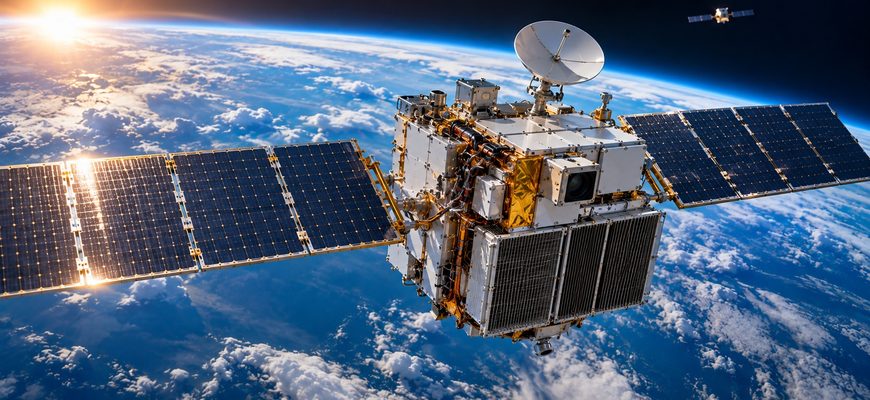
Google has selected Blue Origin to launch AI computing satellites into orbit in 2029, taking a major step toward its vision of solar-powered data centers in space. Announced on November 19, 2026, the agreement will use Blue Origin’s New Glenn rocket to deploy satellites carrying Google’s Tensor Processing Units (TPUs), each designed for computing capacity roughly equivalent to one conventional data-center rack.
The mission is part of Project Suncatcher, Google’s long-term research program exploring whether artificial intelligence can eventually run on large networks of satellites powered by sunlight. But moving AI infrastructure beyond Earth creates challenges that terrestrial data centers rarely face: cooling powerful processors in a vacuum, surviving radiation and moving enormous quantities of data between spacecraft.
Figures describe Google’s announced research roadmap, not a currently operating orbital commercial data center.
- Why Google Wants to Put AI Data Centers in Space
- How Would Solar-Powered AI Satellites Actually Work?
- The Biggest Surprise: Cooling AI Chips Is Harder in Space
- Why Orbital Cooling Changes Everything
- Google Has Already Tested an AI Chip in Orbit
- How AI Satellites Would Communicate With Each Other
- Earth Data Centers vs. Space-Based AI Infrastructure
- What Could Prevent Orbital Data Centers From Replacing Earth Facilities?
- Project Suncatcher Timeline: From Prototype to 2029
- What Happens Next for Google and Blue Origin?
- Project Suncatcher: Frequently Asked Questions
Why Google Wants to Put AI Data Centers in Space
Artificial intelligence requires enormous amounts of computing power. On Earth, that demand increasingly translates into large electricity connections, complex cooling systems, extensive land requirements and new transmission infrastructure.
Google’s idea is to investigate whether some of those constraints could eventually be addressed by placing computing hardware in orbit, where large solar arrays can harvest energy without atmospheric absorption or weather-related interruptions.
According to Google’s November 19 announcement, New Glenn will deploy the Project Suncatcher satellites into sun-synchronous orbit, allowing the spacecraft to benefit from favorable solar illumination conditions.
On Earth, securing sufficient electricity can be one of the most difficult parts of constructing an AI computing facility. Servers.News recently reported how Microsoft withdrew from a planned 23,000-GPU UK data-center deal amid electricity-grid connection delays.
That project and Google’s orbital research are separate initiatives, but they illustrate the same underlying challenge: computing capacity depends on reliable access to energy and infrastructure, not just purchasing advanced processors.

How Would Solar-Powered AI Satellites Actually Work?
Project Suncatcher envisions satellites equipped with Google’s specialized AI chips, large solar arrays and communications systems capable of connecting multiple spacecraft.
Solar panels would convert sunlight into electricity. Power-management systems would distribute that energy to the satellite’s processors, memory, communication equipment and other onboard electronics.
As TPUs perform calculations, they convert much of the energy they consume into heat. That heat must be transported away from sensitive electronics and ultimately radiated into space.
Original Servers.News explanatory schematic. This simplified energy flow omits storage, power conditioning and other spacecraft systems. It is not a diagram of a finalized Google satellite design.
Google’s research suggests that suitable low-Earth-orbit conditions could provide up to eight times more solar power than typical terrestrial collection conditions. That is a company-reported solar-energy comparison, not proof that orbital AI computing would be eight times more efficient.
Spacecraft may still need energy storage or other power-management measures during changes in illumination. A sun-synchronous orbit does not automatically guarantee uninterrupted sunlight for every possible orbital configuration.
The Biggest Surprise: Cooling AI Chips Is Harder in Space
Space is often described as extremely cold, which makes it tempting to assume that cooling processors in orbit would be easy.
The reality is almost the opposite.
On Earth, data centers can move heat away from servers using air, liquid cooling systems, heat exchangers and external cooling infrastructure.
In the vacuum of space, there is no surrounding air to carry heat away through convection.
Heat can move through solid materials and sealed thermal systems inside a spacecraft, but it must ultimately escape through thermal radiation.
Google is investigating cooling approaches that combine heat pipes and radiators. The company has already tested thermal equipment in chambers designed to reproduce vacuum and temperature conditions encountered in space.
Why Orbital Cooling Changes Everything
A satellite capable of running high-density AI hardware must reject substantial waste heat without using surrounding air. Larger radiators add surface area, mass and deployment complexity. This makes thermal engineering one of the defining constraints on how much computing power can fit inside an orbital platform.
Google’s Project Suncatcher engineering overview identifies radiation exposure, launch vibration and cooling as major research challenges that must be addressed before the architecture can scale.
Google Has Already Tested an AI Chip in Orbit
The Blue Origin agreement is not Google’s first experiment with space-based computing.
On October 1, 2026, Google and satellite company Planet launched a Project Suncatcher prototype aboard a SpaceX Falcon 9 rocket as part of the Transporter-18 rideshare mission.
Google subsequently confirmed contact with the satellite and began evaluating the onboard computing hardware.
On October 30, the company announced another milestone: a data-center-class TPU running in orbit had successfully generated an AI response using the Gemma 4 model.
The experiment demonstrated that onboard AI inference could be performed in space under the tested conditions.
However, this was an early technical demonstration. It did not establish that a commercially viable orbital data center could operate continuously at hyperscale capacity.
The October 30 research update says the team will continue measuring TPU performance under radiation and thermal stress.
How AI Satellites Would Communicate With Each Other
Electricity and cooling are only part of the problem.
Large AI models often require processors to exchange substantial amounts of data while coordinating computations. Splitting a workload across many satellites introduces a difficult networking challenge.
Google is researching high-bandwidth optical links that would allow satellites to communicate with neighboring spacecraft using precisely directed lasers.
Maintaining reliable links between moving platforms requires accurate positioning, alignment and tracking. The system must also account for communication delays, limited ground connectivity and the possibility of individual spacecraft becoming temporarily unavailable.
Google plans to test connections between two satellites in 2027. The results should help establish whether the proposed architecture can support more demanding distributed AI workloads.
Earth Data Centers vs. Space-Based AI Infrastructure
Orbital computing offers an unusual opportunity, but it also replaces familiar terrestrial infrastructure constraints with new engineering problems.
| Factor | Earth Data Center | Orbital AI Platform |
|---|---|---|
| Electricity | Grid connections, generation contracts and backup power | Solar arrays, power conditioning and possible energy storage |
| Cooling | Air or liquid systems with heat rejection to the environment | Internal thermal transport and radiative heat rejection |
| Connectivity | High-capacity fiber networks and terrestrial interconnects | Optical satellite links and ground communication |
| Maintenance | Direct physical access for equipment replacement | Limited servicing opportunities; remote operation is essential |
| Deployment | Construction, grid and regulatory requirements | Launch capacity, spacecraft production and orbital operations |
The comparison also explains why conventional data centers are unlikely to disappear simply because orbit offers attractive sunlight conditions.
A terrestrial facility can replace damaged hardware, upgrade networking equipment and service cooling systems without launching a spacecraft. These operational advantages remain substantial for large-scale computing.

What Could Prevent Orbital Data Centers From Replacing Earth Facilities?
Several significant barriers remain between Google’s research demonstration and a scalable commercial service.
- Launch economics. Processors, solar arrays, radiators and supporting equipment must all be transported into orbit. Launch and replacement costs could outweigh potential energy benefits.
- Thermal capacity. Increasing compute density also increases the amount of heat that the spacecraft must reject. Thermal hardware consumes mass, space and engineering resources.
- Radiation and reliability. Cosmic rays and solar particles can damage electronics or introduce computing errors.
- Networking. Distributed AI workloads require substantial bandwidth and reliable communication between processors.
- Maintenance and orbital safety. Failed components cannot be replaced as easily as in a terrestrial data center. Orbital debris, collision avoidance and end-of-life disposal add further operational requirements.
Google’s terrestrial expansion plans also remain substantial. As Servers.News reported in September , the company committed major investment to new AI infrastructure in Finland, supported by long-term electricity arrangements.
Space-based AI computing is therefore better understood as an experimental alternative architecture, not a replacement already being deployed for Google’s existing data centers.
Project Suncatcher Timeline: From Prototype to 2029
- OCTOBER 1, 2026 First Prototype Reaches Orbit Google and Planet launch a TPU-equipped research satellite on a SpaceX rideshare mission.
- OCTOBER 30, 2026 First AI Response in Space Google reports successful AI inference using Gemma 4 aboard its prototype.
- 2027 — PLANNED Two-Satellite Networking Test Google aims to evaluate optical connections between spacecraft as part of its research roadmap.
- Q1 2029 — TARGETED Dedicated Blue Origin Launch New Glenn is scheduled to deploy larger-scale computing satellites into sun-synchronous orbit. This is a planned launch, not a completed deployment.
What Happens Next for Google and Blue Origin?
The November 19 agreement gives Blue Origin a dedicated future heavy-lift mission for New Glenn while moving Project Suncatcher beyond its initial prototype phase.
Google’s next technical milestones include extended monitoring of its first orbital TPU, optical communication tests between satellites and further development of thermal systems.
The company has not announced commercial pricing, customer availability, the total cost of the 2029 mission or a timetable for operating a full orbital AI data-center network.
The remaining question is not whether an AI chip can perform calculations in orbit. Google has already demonstrated that capability.
The harder question is whether thousands of high-performance processors can be powered, cooled, connected and operated in space at a cost competitive with infrastructure on Earth.
Project Suncatcher: Frequently Asked Questions
Has Google already launched an AI satellite?
Yes. A Project Suncatcher prototype launched on October 1, 2026, and Google subsequently reported successful TPU-based AI inference. The larger Blue Origin mission remains planned for 2029.
Will solar power make orbital computing free?
No. Sunlight does not eliminate spacecraft manufacturing, launch, power management, communications, cooling or replacement costs. Google has not demonstrated that orbital computing is commercially cheaper than terrestrial computing.
Can a data center be cooled in space?
Yes, in principle. Heat can be moved internally through appropriate thermal systems and rejected by radiators. The challenge is making that process reliable and sufficiently efficient for very dense AI hardware.
Will Google’s satellites replace ordinary data centers?
There is no announced plan to replace terrestrial data centers. Project Suncatcher remains an experimental research initiative exploring whether orbital computing could eventually become a practical additional infrastructure option.
Bottom line: Google’s partnership with Blue Origin makes orbital AI computing a more concrete engineering project. But the future of space-based data centers will depend on much more than abundant sunlight. Cooling, networking, reliability and launch economics will determine whether Project Suncatcher can evolve from a successful experiment into practical large-scale infrastructure.
Reporting basis: Google’s November 19, 2026, Project Suncatcher announcement; Blue Origin’s launch agreement; Google’s October orbital prototype updates and engineering research; and independent reporting by Reuters. Spacecraft performance, future launch timing and solar-power potential are attributed to the organizations making those claims. NASA photographs are used only to illustrate established orbital infrastructure and do not depict Google’s Project Suncatcher spacecraft.