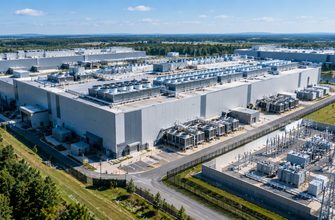
The Marvell Lumentum deal is one of the largest technology acquisitions announced in 2026, with an implied enterprise value of $115 billion. Marvell Technology has agreed to acquire optical-components specialist Lumentum in an all-stock transaction aimed at expanding its position in AI data center networking.
Announced on November 2, the proposed acquisition combines Marvell’s semiconductor and networking expertise with Lumentum’s laser, optical transceiver and photonics technologies. The companies expect the transaction to close in the first half of 2028, subject to shareholder and regulatory approvals.
Figures are based on the November 2 announcement. The transaction has not closed, and the stated enterprise value is based on the deal’s announced valuation assumptions.
Marvell Lumentum Deal: The $115 Billion Terms
Under the definitive agreement , Lumentum shareholders will receive 4.5 shares of Marvell common stock for each Lumentum share.
The exchange ratio is fixed, meaning the market value of the consideration can change as Marvell’s share price moves.
The companies said the transaction implies a $115 billion enterprise value for Lumentum, or approximately $1,132 per share, based on the announced valuation assumptions.
The implied premium was approximately 23.9% relative to the unaffected closing share prices on October 28, before market speculation about the transaction.
| Deal Metric | Announced Terms |
|---|---|
| Transaction | Marvell to acquire Lumentum |
| Consideration | All-stock exchange |
| Exchange ratio | 4.500 Marvell shares per Lumentum share |
| Implied enterprise value | $115 billion |
| Implied equity value | Approximately $102.5 billion |
| Implied premium | Approximately 23.9% |
| Expected completion | First half of 2028 |
Sources: Marvell’s SEC Form 8-K and Reuters . Enterprise value and equity value are different financial measures.
Who Would Own the Combined Company?
After closing, existing Marvell shareholders are expected to own approximately 67% of the combined company, with Lumentum shareholders holding approximately 33%, on a fully diluted basis.
Illustrative chart based on the companies’ pro forma ownership disclosure. Actual ownership will depend on completion of the transaction.
Why AI Data Centers Are Moving Toward Optical Connectivity
The strategic rationale behind the Marvell Lumentum deal extends beyond conventional semiconductor consolidation.
Large AI clusters must move data between accelerators, network switches, storage systems and other compute infrastructure. As clusters scale, network bandwidth, latency and power consumption become increasingly important.
Copper interconnects remain important for short-distance communication. However, their electrical losses and power requirements become more challenging at greater distances and higher data rates.
Optical connectivity can carry high-bandwidth signals across longer distances and, in appropriate architectures, help reduce the energy and signal-integrity challenges associated with electrical links.
The industry is also exploring closer integration of optical components with switching and computing silicon.

For AI infrastructure operators, the importance of optical networking is not simply faster communication. Better connectivity can influence cluster topology, the number of network hops, system power requirements and the practical scale of distributed computing.
What Marvell and Lumentum Bring to AI Networking
Marvell has developed technologies spanning network switching, digital signal processing, custom AI accelerators and semiconductor interconnects.
Lumentum contributes expertise in lasers, optical transceivers, optical circuit switching and specialized compound semiconductor manufacturing, including indium phosphide.
The combined technology portfolio could allow closer coordination between electronic signal processing and the optical components that transmit data.
In its official announcement , Lumentum said the companies intend to develop more integrated, pre-validated connectivity solutions for future AI infrastructure.
How the Optical Signal Chain Fits Together
Simplified Servers.News explanatory diagram. Real optical links also require receiver-side components and may use different packaging, modulation and switching architectures.
The technical opportunity is to co-design more of this signal chain instead of optimizing individual components in isolation.
That could help customers develop higher-bandwidth and more power-efficient network architectures. But the transaction alone does not establish a measured improvement for any particular AI cluster.

A $550 Billion Market Ambition — Not Guaranteed Revenue
The companies project that the Marvell Lumentum deal could expand their combined total addressable market to approximately $550 billion.
That figure is a management estimate of potential market opportunity. It is not current annual revenue, the value of signed customer contracts or a guaranteed future market size.
Marvell also expects more than $1 billion in annual run-rate cost synergies and says the acquisition should contribute positively to non-GAAP earnings per share in the first year following completion.
These are forward-looking management expectations. Achieving them will depend on integration, manufacturing execution, customer demand and the costs of combining the businesses.
Independent Reuters reporting also highlighted investor concern over the transaction’s valuation and the sustainability of aggressive AI infrastructure spending.
The broader context is a rapid expansion in cloud computing investment. Servers.News recently compared AWS, Azure and Google Cloud’s Q3 2026 earnings , documenting the revenue growth and capital spending that underpin demand for new computing and networking equipment.
What Could Delay the Marvell Lumentum Deal?
The proposed transaction requires approvals from shareholders of both companies, regulatory clearances and satisfaction of other closing conditions.
Marvell expects completion in the first half of calendar 2028. Until then, the companies remain separate businesses.
The fixed exchange ratio introduces market-price exposure. If Marvell’s share price changes materially, the market value of the stock consideration changes as well.
There are also operational questions about integrating semiconductor design, optical-component manufacturing, research programs and customer relationships.
The transaction’s impact on the AI data center market cannot be assessed solely from its headline enterprise value.
What to Watch Next
- Regulatory reviews: whether the acquisition obtains the required approvals in relevant jurisdictions.
- Shareholder votes: whether investors in both companies approve the proposed merger.
- Technical roadmap: whether the companies provide concrete milestones for more integrated optical connectivity products.
- Manufacturing and supply: whether planned integration improves production capacity and reliability.
- Financial execution: whether expected cost synergies and growth materialize after closing.
Why the Acquisition Matters Beyond Its Price
The $115 billion Marvell Lumentum deal demonstrates the growing strategic importance of connectivity in AI infrastructure.
Faster accelerators alone cannot determine the performance of large computing clusters. Data must move efficiently between processors, switches, storage and sometimes separate facilities.
As AI systems expand, optical communication is becoming an increasingly important part of the infrastructure investment equation.
Marvell’s proposed acquisition of Lumentum is a major bet on that transition. Whether it ultimately delivers the anticipated technical and financial benefits will depend on approvals, integration and real-world customer adoption.