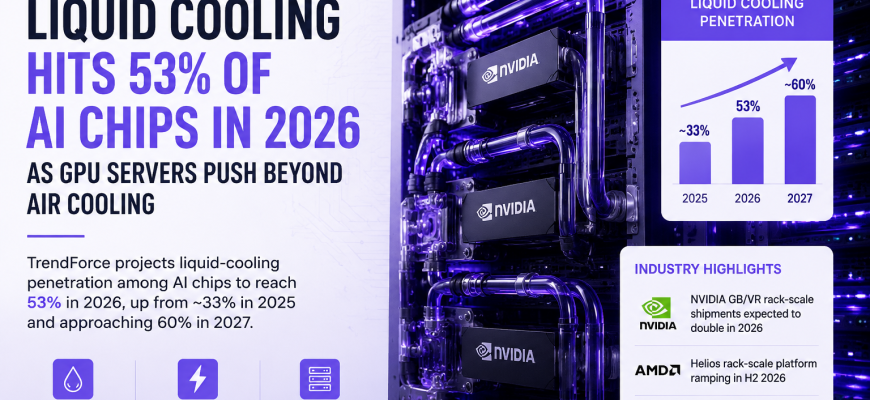
Liquid cooling is rapidly moving from a specialized option to standard equipment for high-end AI infrastructure. New research from TrendForce says adoption among AI chips is expected to jump from roughly 33% in 2025 to 53% in 2026.
The reason is becoming difficult to ignore: the latest accelerators from NVIDIA, AMD and Google are producing more heat than conventional server designs were built to handle. Individual AI chips have pushed beyond the 1 kW thermal-design-power mark, while complete rack-scale systems can consume hundreds of kilowatts.
For the dedicated GPU server market, this is more than a cooling upgrade. It is changing how servers, racks and even entire data centers have to be designed.
TrendForce now expects liquid-cooling penetration among AI chips to reach 53% this year and approach 60% in 2027, making liquid cooling increasingly standard for high-end AI infrastructure.
That compares with approximately 33% in 2025 — a remarkably fast change for technology that was considered specialized infrastructure only a few years ago.
- Three Numbers Explain the Shift
- Why Is This Happening Now?
- NVIDIA Is One of the Biggest Drivers
- AMD Is Moving in the Same Direction
- Google Is Already Far Ahead
- NVIDIA, AMD and Google: Where Things Stand
- Why Air Cooling Is Becoming the Bottleneck
- What Liquid Cooling Actually Does
- This Isn’t Just a Server Hardware Story
- Power Per Rack Is Becoming a Critical Metric
- What This Means for Dedicated GPU Hosting
- Does This Mean Every Server Will Become Liquid Cooled?
- Why the 53% Threshold Matters
- What to Watch Next
- Bottom Line
Three Numbers Explain the Shift
The trajectory is significant because it suggests liquid cooling is crossing the line between a niche solution and mainstream infrastructure for high-performance AI systems.
Why Is This Happening Now?
AI hardware is getting extremely power hungry.
The latest generation of accelerators doesn’t just increase compute performance. It concentrates enormous amounts of electrical power — and therefore heat — into a very small physical area.
TrendForce says the TDP of individual high-end AI chips has now generally moved beyond 1 kW.
At rack scale, the numbers become even more dramatic. Complete AI server solutions can consume hundreds of kilowatts.
Almost all of the electricity consumed by computing hardware eventually becomes heat. So a rack drawing hundreds of kilowatts also creates an enormous cooling problem. At that density, simply installing faster fans and moving more air becomes increasingly difficult and inefficient.
NVIDIA Is One of the Biggest Drivers
NVIDIA’s move toward rack-scale AI systems is helping accelerate the transition.
According to TrendForce, shipments of NVIDIA’s GB and VR rack-scale solutions are expected to double in 2026, driven by continued AI infrastructure investment from data-center operators and cloud providers.
And demand is not expected to stop there.
Even with potential timing uncertainty around future platforms, TrendForce expects overall NVIDIA GPU rack shipments to continue growing by more than 30% year over year in 2027.
A high-end GPU is no longer necessarily being deployed as a standalone PCIe device inside a conventional server.
The market is increasingly moving toward complete rack-scale computing platforms where GPUs, CPUs, networking, power delivery and cooling are designed as one system.
AMD Is Moving in the Same Direction
NVIDIA isn’t alone.
AMD is expanding beyond individual accelerators toward complete AI infrastructure platforms.
TrendForce says AMD is focusing on its Helios rack-scale AI solution in the second half of 2026, integrating CPUs, GPUs and high-speed interconnects into a larger platform.
Larger-scale Helios shipments are expected in 2027, while AMD continues developing its MI450 platform and the next-generation MI500 architecture.
The important part from an infrastructure perspective is that these high-end platforms are embracing liquid cooling as part of their design.
Google Is Already Far Ahead
Perhaps the most striking number in TrendForce’s research isn’t 53%.
It’s Google’s current adoption rate.
According to TrendForce, Google has moved aggressively toward customized liquid-cooling architectures for its AI infrastructure.
Google’s approach includes technologies such as cold plates, manifolds and cooling distribution units, or CDUs.
That is important because hyperscale operators often encounter infrastructure problems before the broader server market does.
What begins inside the largest AI data centers can eventually influence standard GPU server designs and hosting infrastructure.
NVIDIA, AMD and Google: Where Things Stand
| Company | 2026 Direction | Cooling Impact |
|---|---|---|
| NVIDIA | Growing GB/VR rack-scale deployments | Increasing dependence on liquid-cooled rack infrastructure |
| AMD | Moving toward Helios rack-scale AI systems | Liquid cooling becomes part of the platform architecture |
| Large-scale internal AI infrastructure | Already uses liquid cooling in more than 80% of AI servers |
Why Air Cooling Is Becoming the Bottleneck
Air cooling isn’t suddenly obsolete.
For ordinary dedicated servers, storage systems, VPS hosts and many enterprise workloads, it remains simple, reliable and effective.
The problem appears when compute density becomes extreme.
Fans have to move enough air through the chassis to carry the heat away. As thermal density increases, the amount of required airflow rises as well.
Eventually, there are practical limits to how much air can efficiently be pushed through a server and rack.
Liquid changes the equation because it can transport concentrated heat much more effectively.
What Liquid Cooling Actually Does
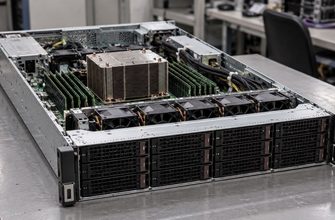
One increasingly common approach is direct-to-chip cooling.
Instead of relying entirely on a heatsink and airflow, a cold plate sits directly on a high-power component such as a GPU or CPU.
Coolant flows through the plate, absorbs the heat and transports it away from the server.
That allows much larger amounts of heat to be removed without requiring an equally dramatic increase in airflow.
| Traditional Air Cooling | Liquid Cooling | |
|---|---|---|
| Standard servers | Excellent | Often unnecessary |
| High-power GPUs | Increasingly challenging | Well suited |
| Very dense racks | Major challenge | Designed for high heat density |
| Infrastructure | Simpler | Requires coolant distribution |
| Future AI racks | More limited | Increasingly standard |
This Isn’t Just a Server Hardware Story
The shift to liquid cooling has implications far beyond the server chassis.
A hosting company cannot necessarily take a next-generation rack-scale GPU system and install it into any available rack.
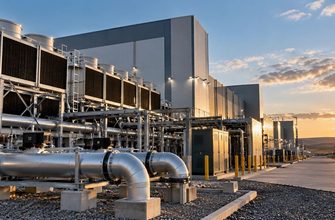
The data center itself has to support it.
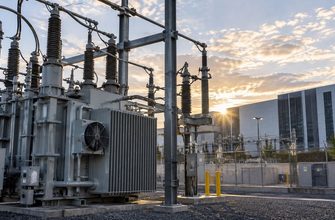
- The rack needs enough electrical capacity.
- The facility must remove enormous amounts of heat.
- Coolant distribution infrastructure may be required.
- High-speed networking must connect GPU nodes.
- Power and cooling systems need enough capacity for future upgrades.
That makes the physical infrastructure behind dedicated GPU hosting much more important.
Power Per Rack Is Becoming a Critical Metric
Historically, hosting companies could think about capacity partly in terms of rack space: how many servers can we physically install?
AI changes that calculation.
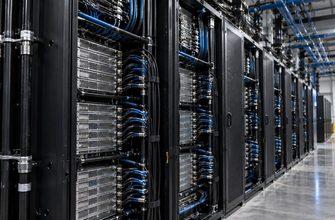
A rack may have plenty of empty units and still be effectively full because it has reached its power or cooling limit.
For high-density GPU hosting, available rack space can matter less than how many kilowatts the rack can deliver and how much heat the facility can remove.
What This Means for Dedicated GPU Hosting
This transition could gradually separate GPU hosting from conventional dedicated-server hosting.
Buying powerful GPUs is only one part of the equation.
Providers increasingly need the infrastructure around those GPUs.
High-density GPU racks require far more electrical capacity than conventional server racks.
Future platforms increasingly require infrastructure capable of supporting direct liquid cooling.
Large AI clusters need extremely fast interconnects between GPUs and server nodes.
For customers renting dedicated GPU infrastructure, this could eventually make the data center itself almost as important as the GPU model listed on the product page.
Does This Mean Every Server Will Become Liquid Cooled?
No — and the 53% forecast shouldn’t be interpreted that way.
The TrendForce figure concerns liquid-cooling penetration among AI chips, not all servers deployed worldwide.
Conventional air cooling will remain dominant across enormous parts of the server market.
Web servers, VPS nodes, storage servers, database machines, network appliances and many traditional dedicated systems simply don’t generate enough concentrated heat to require liquid cooling.
The transition is happening first at the extreme end of computing: high-density AI and GPU infrastructure.
Why the 53% Threshold Matters
The most important part of TrendForce’s forecast may not be the exact percentage.
It is the speed of the transition.
Liquid cooling penetration is projected to move from roughly 33% to 53% in just one year and then approach 60% in 2027.
When adoption reaches that scale, suppliers have much stronger incentives to standardize components, improve cooling distribution systems and design facilities around liquid-cooled hardware from the beginning.
This looks less like a temporary response to one unusually hot generation of GPUs and more like a structural change in high-end server design.
The industry is moving from thinking about the GPU as a component toward thinking about the entire rack as the computing platform.
What to Watch Next
The next 12 to 18 months should show how quickly this transition spreads beyond the largest hyperscale deployments.
Three developments will be particularly important:
- How quickly NVIDIA’s new rack-scale platforms ramp in volume.
- Whether AMD’s Helios architecture gains meaningful deployment momentum.
- How quickly colocation and dedicated-server providers retrofit facilities for higher rack densities and liquid cooling.
If TrendForce’s forecast proves accurate, liquid cooling will no longer be an unusual feature worth mentioning on a high-end AI server.
It will increasingly be something buyers simply expect.
Bottom Line
Liquid cooling is moving into the mainstream of high-end AI infrastructure much faster than it did in conventional server computing.
TrendForce expects penetration among AI chips to rise from around 33% in 2025 to 53% in 2026 and approach 60% in 2027.
With individual AI chips exceeding 1 kW and rack-scale systems consuming hundreds of kilowatts, cooling has become a fundamental part of GPU server architecture — not an accessory added afterward.
For the dedicated server industry, the message is clear: the next battle in GPU hosting won’t be fought only over who has the fastest accelerators. Power, cooling and rack infrastructure are becoming part of the product.