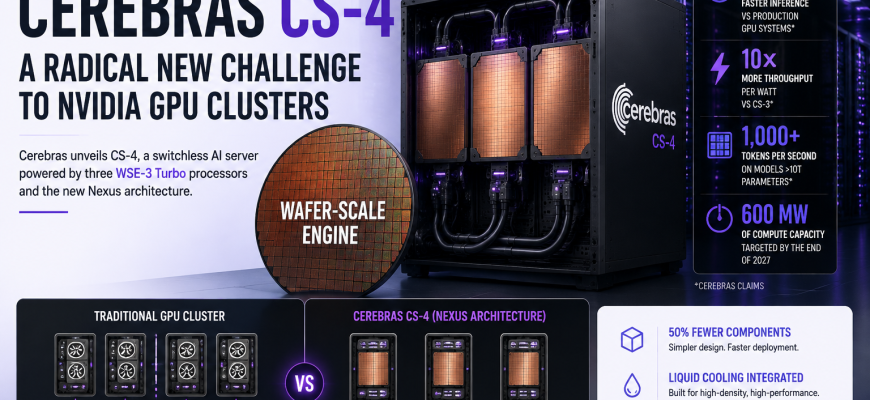
Cerebras has unveiled the CS-4, a new rack-scale AI inference system built around three upgraded wafer-scale processors — and its architecture looks very different from the GPU clusters that dominate AI infrastructure today.
The company says the system can deliver up to 30× faster inference than production GPU systems, while its new Nexus architecture reduces component count, simplifies deployment and allows some Cerebras systems to communicate directly without conventional network switches.
For a market increasingly dominated by gigantic GPU clusters, CS-4 is a very different bet: make the processor enormous, reduce the number of devices needed to run a model and attack the communication bottleneck directly.
The CS-4 is the first system based on Cerebras’ new Nexus rack-scale architecture. Each system uses three WSE-3 Turbo wafer-scale processors in modular compute assemblies and introduces redesigned power delivery, cooling and I/O.
The figure comes from Cerebras’ own benchmarks and third-party performance comparisons across selected AI models, so it should be viewed as a vendor performance claim rather than a universal result for every workload.
- CS-4 Is Not a Normal AI Server
- Three WSE-3 Turbo Processors Per System
- The Most Interesting Part May Be the Rack
- What Is a Wafer-Scale Backpack?
- The Switchless Part Is Particularly Interesting
- CS-4 Still Supports Standard Ethernet
- Cerebras Is Also Embracing Other Accelerators
- AMD Helios and AWS Trainium Can Work With CS-4
- AMD and Cerebras Are Already Working Together
- How Different Is This From a GPU Cluster?
- 30× Faster Than GPUs? Read That Number Carefully
- Cerebras Says Throughput Per Watt Is Improving Too
- 600 MW of Compute by the End of 2027
- Why CS-4 Matters for the Server Industry
- Is This Really a Threat to NVIDIA?
- AI Agents Make Fast Tokens More Valuable
- What Happens Next?
- Bottom Line
CS-4 Is Not a Normal AI Server
The easiest way to understand Cerebras is to forget what a conventional accelerator card looks like.
A normal AI server might contain several individual GPUs. Large models are distributed across those devices, and the GPUs need to constantly exchange data through high-speed interconnects and networking.
Cerebras takes a radically different approach.
Its Wafer-Scale Engine is built using almost an entire silicon wafer as one enormous processor.
The idea is simple in principle: if much more of the model can live on one giant piece of silicon, less time has to be spent moving information between thousands of smaller chips.
Instead of dividing compute across many conventional accelerator packages, Cerebras uses a wafer-scale processor.
The new architecture targets communication delays that become critical as AI models grow.
Nexus separates compute, power and I/O into modules designed for faster deployment and upgrades.
Three WSE-3 Turbo Processors Per System
The CS-4 contains three new WSE-3 Turbo processors.
Cerebras says each Turbo processor can deliver up to twice the speed of the previous generation.
The company is achieving that not just through changes to the processor itself, but by redesigning the hardware surrounding it.
Power conversion has been moved much closer to the processor, the cooling system is integrated into the compute assembly, and I/O has been redesigned to reduce latency.
The Most Interesting Part May Be the Rack
The processor is dramatic, but Cerebras is putting just as much emphasis on the new Nexus Platform Architecture.
Nexus rethinks the AI rack around three major systems:
- Compute
- Power
- I/O
Instead of building the rack as a tightly interconnected collection of individual boards and subsystems, Cerebras is turning these functions into larger modular assemblies.
The company says that design cuts the component count by roughly 50%.
Cerebras says its new Wafer-Scale Backpack design can reduce deployment time from days to hours, while using 50% fewer components than the previous generation.
What Is a Wafer-Scale Backpack?
It’s essentially a self-contained compute module built around the wafer.
The module integrates:
- the wafer-scale processor;
- power conversion;
- direct liquid cooling;
- high-speed I/O;
- control electronics.
The module mounts vertically at the rear of the system and can be installed independently of much of the rack infrastructure.
Cerebras says this separation means data centers can install and qualify power, cooling and networking first, then slide compute modules into place later.
The Switchless Part Is Particularly Interesting
Large GPU clusters depend heavily on networking.
As models are split across accelerators, information has to move from one processor to another quickly enough that communication does not destroy inference performance.
That usually means extremely expensive high-speed switches and network fabrics.
CS-4 introduces what Cerebras calls Direct Wafer Links.
These links allow Cerebras systems to connect directly within or across racks without an intermediate network switch.
Switches are not inherently bad — modern GPU clusters depend on them for a reason.
But each additional network hop adds hardware, cost, power consumption and latency.
If Cerebras can directly connect wafer-scale processors for workloads that would otherwise require a large switched GPU fabric, that could simplify part of the cluster architecture significantly.
CS-4 Still Supports Standard Ethernet
Cerebras is not trying to create a completely isolated infrastructure island.
The new I/O subsystem also supports standards-based RoCE v2 RDMA over Ethernet.
That gives operators two options:
| Connection | Purpose |
|---|---|
| RoCE v2 Ethernet | Connect CS-4 to existing data-center infrastructure and heterogeneous AI systems. |
| Direct Wafer Links | Connect Cerebras wafers directly without switches for extremely low-latency communication. |
Cerebras Is Also Embracing Other Accelerators
One of the more surprising parts of the strategy is that Cerebras is not positioning CS-4 as something that has to replace every GPU or ASIC in a data center.
The system supports disaggregated inference.
An AI inference request generally has two broad stages:
- Prefill: process the incoming prompt and build the model state.
- Decode: generate the output tokens the user actually sees.
Cerebras wants CS-4 to specialize in ultra-fast decoding while another system handles prefill.
That other platform can be a GPU or ASIC.
AMD Helios and AWS Trainium Can Work With CS-4
Cerebras specifically identifies AMD Helios and AWS Trainium as complementary prefill platforms.
That matters because it makes the architecture less of a simple “Cerebras versus GPU” story.
An operator could theoretically use hardware that is particularly efficient for prompt processing and then hand the model state to Cerebras for very fast token generation.
The future AI data center may not be built around one accelerator architecture. It may contain GPUs, ASICs and wafer-scale processors, with each doing the part of inference it handles best.
AMD and Cerebras Are Already Working Together
This isn’t hypothetical.
AMD and Cerebras announced a partnership in July to combine AMD Helios rack-scale infrastructure with Cerebras Wafer-Scale Engine systems for disaggregated inference.
The joint system is expected to become available through Cerebras Cloud in the second half of 2026.
That is especially interesting because AMD is itself one of NVIDIA’s largest GPU competitors.
Instead of every alternative architecture fighting independently, the AI infrastructure market is beginning to show signs of specialization and cooperation.
How Different Is This From a GPU Cluster?
| Conventional GPU Cluster | Cerebras CS-4 Approach | |
|---|---|---|
| Compute units | Many separate GPUs | Large wafer-scale processors |
| Scaling | High-speed GPU fabrics | Direct wafer links + Ethernet |
| Network switches | Critical to large clusters | Some wafer connections can be switch-free |
| Cooling | Air or liquid depending on platform | Direct liquid cooling integrated into module |
| Deployment model | GPU-centric rack infrastructure | Modular Nexus architecture |
30× Faster Than GPUs? Read That Number Carefully
Cerebras is making a very aggressive performance claim.
It says CS-4 can deliver inference speeds up to 30 times faster than production GPU systems across the model set used in its testing.
That is impressive — but the phrase “up to” matters.
AI inference performance depends on model architecture, batch size, prompt length, output length, quantization, software stack and what exactly is being optimized.
So 30× should not be interpreted as “CS-4 is 30× faster than every GPU system in every workload.”
The more important claim may not be the peak 30× figure.
The real architectural question is whether wafer-scale compute can maintain very high interactive token rates as models become larger without requiring the huge communication fabrics used by conventional accelerator clusters.
Cerebras Says Throughput Per Watt Is Improving Too
Speed is only useful if the data center can afford to power it.
Cerebras says CS-4 offers up to 10× more throughput per watt than CS-3.
The company has redesigned power delivery so conversion happens just 0.5 millimeters from the processor — roughly 100 times closer than the distance Cerebras compares with conventional GPU boards.
That allows more power to reach the wafer while reducing board-level losses.
600 MW of Compute by the End of 2027
Cerebras is also planning a major expansion of its own infrastructure footprint.
CEO Andrew Feldman told Reuters that the company aims to make approximately 600 megawatts of computing capacity available by the end of 2027.
Cerebras separately announced plans for 200 MW of capacity in Europe by the end of 2027, including infrastructure in France and the Nordic region.
The expansion shows that the company is no longer pitching wafer-scale computing only as exotic hardware — it is trying to turn it into a large-scale AI inference platform.
Why CS-4 Matters for the Server Industry
The biggest takeaway isn’t simply that another AI accelerator has launched.
CS-4 represents a broader challenge to one of the central assumptions behind modern AI infrastructure:
that scaling AI requires enormous clusters of separate accelerator chips connected through increasingly complex network fabrics.
Cerebras is asking whether some of that complexity can be eliminated by making the processor itself dramatically larger.
Nexus is designed around larger modular assemblies instead of a huge collection of independent rack components.
Direct Wafer Links can eliminate switches from some Cerebras-to-Cerebras connections.
The company says modular compute backpacks can reduce installation time from days to hours.
Is This Really a Threat to NVIDIA?
Not in the sense that NVIDIA’s GPU business suddenly disappears.
NVIDIA has a gigantic software ecosystem, enormous manufacturing scale, highly mature networking products and an installed base that Cerebras does not come close to matching.
GPU infrastructure is also much more flexible across a broad range of workloads.
But inference is becoming such a large market that alternative architectures do not necessarily need to replace NVIDIA everywhere.
They only need to be significantly better at particular high-value workloads.
Ultra-low-latency inference — especially for reasoning models, AI agents and interactive coding systems — is one of those workloads.
AI Agents Make Fast Tokens More Valuable
This matters because AI usage is changing.
A simple chatbot may generate a relatively modest response.
An AI coding agent can repeatedly inspect files, reason, call tools, modify code and generate many times more tokens during a single task.
As models do more work autonomously, the time required to generate each token becomes increasingly noticeable.
That makes inference latency a competitive infrastructure metric rather than a cosmetic benchmark.
What Happens Next?
The first CS-4 shipments are scheduled to begin this quarter.
The next question is whether Cerebras can scale the architecture as aggressively as it plans.
Three things are worth watching:
- Whether independent benchmarks reproduce the largest CS-4 performance claims.
- How quickly Cerebras can deploy hundreds of megawatts of new capacity.
- Whether hyperscalers and AI cloud providers adopt Nexus beyond Cerebras’ own infrastructure.
The switchless architecture will also be worth watching closely.
If direct wafer links can scale large AI systems without requiring the same network complexity as GPU clusters, that could have implications for networking costs, rack design and power consumption across future AI infrastructure.
Bottom Line
Cerebras CS-4 is not simply a faster version of CS-3.
The company has redesigned the entire system around three WSE-3 Turbo processors, modular compute backpacks, integrated liquid cooling, higher-density power delivery and a new I/O fabric capable of switch-free wafer-to-wafer connections.
Cerebras claims up to 30× faster inference than selected production GPU systems, more than 1,000 tokens per second on models above 10 trillion parameters and substantially improved throughput per watt.
Whether those advantages translate across real-world workloads remains to be tested independently.
But the architecture itself is significant. At a time when the rest of the industry is building ever-larger clusters of individual GPUs, Cerebras is betting that the better answer may be to use fewer, much larger processors — and remove as much communication overhead as possible.