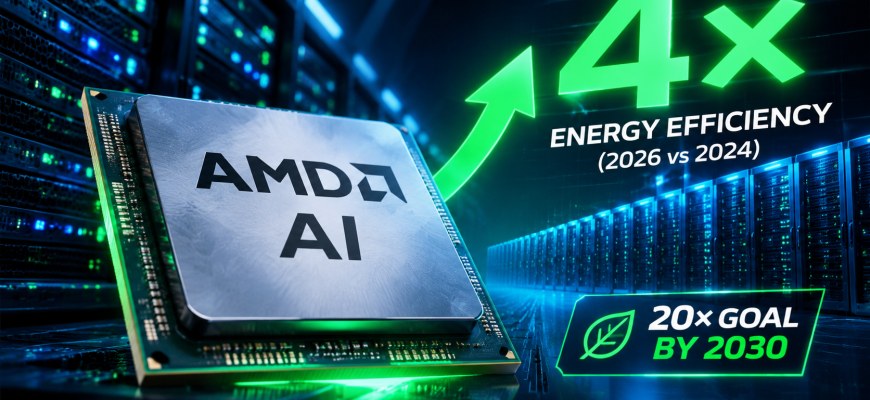
AMD says its 2026 rack-scale AI infrastructure delivers an estimated four times the energy efficiency of its 2024 systems, putting the company ahead of its roadmap toward a 20× improvement by 2030.
The company announced the milestone on August 18 as power consumption, cooling and rack density become increasingly important constraints for large AI data centers.
- 4× estimated efficiency improvement from 2024 to 2026.
- AMD says it is ahead of its current roadmap target.
- The measurement covers rack-scale AI infrastructure, not only individual GPUs.
- AMD is targeting a 20× improvement by 2030.
AMD Reports 4× Efficiency Gain
AMD says it has achieved an estimated 4× increase in AI energy efficiency between 2024 and 2026, exceeding the target the company had set for this stage of its roadmap.
Rather than measuring only the efficiency of an individual GPU, AMD is looking at performance per watt across the complete rack-scale system.
That includes improvements in compute performance, memory bandwidth, high-speed interconnects and software optimization.
AMD says system-level engineering has pushed rack-scale AI efficiency ahead of its planned improvement rate.
Why AMD Is Measuring the Entire AI Rack
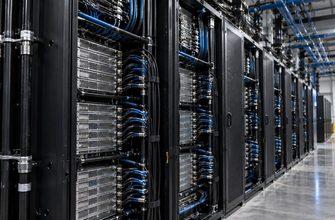
The change in measurement reflects a broader shift in AI infrastructure. Modern AI systems are increasingly built and optimized as complete racks rather than collections of independent GPU servers.
A faster accelerator alone does not guarantee an efficient AI system. GPUs need high-bandwidth memory, fast interconnects, CPUs, networking and software capable of keeping the hardware utilized.
AMD Still Targets 20× by 2030
The 4× result is an intermediate milestone. AMD’s larger target is to deliver a 20× increase in rack-scale energy efficiency for AI training and inference between 2024 and 2030.
That target is becoming particularly relevant as AI infrastructure expands into increasingly large clusters.
Higher performance per watt allows operators to install more computing capacity within the same power envelope — potentially reducing the number of racks, electricity requirements and cooling infrastructure needed for a given workload.
Power Efficiency Becomes a Bigger AI Data Center Issue
The announcement comes as the competition between AMD, NVIDIA and other AI hardware vendors increasingly moves beyond raw accelerator performance.
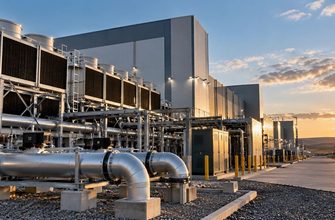
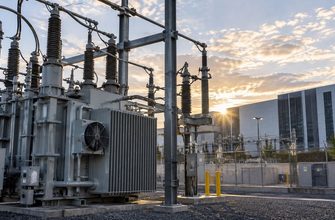
Power availability, cooling capacity and rack density are becoming major factors in determining how much AI compute a data center can actually deploy.
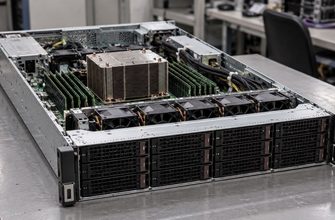
AMD’s newest Helios platform illustrates this shift. The rack-scale system connects 72 Instinct MI455X GPUs with EPYC server CPUs and Pensando networking, treating the entire rack as a co-designed AI system rather than simply a collection of servers.
The AI hardware race is no longer only about which company builds the fastest GPU. How much useful AI compute can fit inside a rack — and within a data center’s available power budget — is becoming just as important.
There is an important caveat: AMD’s 4× figure is an internal estimate based on the company’s own rack-scale methodology, rather than an independent cross-vendor benchmark.
Even so, the announcement highlights an important direction for the server industry: the rack itself is increasingly becoming the unit by which AI infrastructure is designed and evaluated.