Saudi Aramco and the Public Investment Fund (PIF) completed a transaction on November 1, 2026, giving the energy company a 49% stake in HUMAIN, Saudi Arabia’s state-backed artificial intelligence venture. The agreement involves approximately $2.6 billion in Aramco cash contributions during 2026, alongside AI and digital assets, and supports HUMAIN’s ambition to deploy 3 gigawatts of AI data-center capacity by 2030.
The official announcement confirms that PIF will retain majority ownership with a 51% stake. For AI infrastructure operators, the Aramco HUMAIN deal brings a major energy company into an expanding compute business, but it does not establish that HUMAIN’s entire 3GW pipeline has been built, funded or connected to the electricity grid.
Aramco HUMAIN Deal Closes After a Year of Planning
The transaction follows a non-binding term sheet announced on October 28, 2025. At that stage, Aramco and PIF outlined plans to combine their AI investments, capabilities and personnel under HUMAIN while keeping the sovereign wealth fund as majority owner.
The November 1 announcement moves the arrangement from a proposal to a completed ownership transaction. Aramco holds its interest through a wholly owned subsidiary and expects to use HUMAIN’s computing services for industrial AI applications.
The $2.6 billion figure is significant, but it should not be interpreted as a dedicated budget for data-center construction. The agreement also transfers assets whose individual values have not been publicly itemized in the announcement.
What Does HUMAIN’s 3GW Data Center Target Actually Mean?
HUMAIN says it aims to deploy 3 gigawatts of AI data-center capacity by 2030. That represents 3,000 megawatts of planned capacity across the company’s expansion strategy.
It is a power-capacity measure, not an annual electricity-consumption figure or a confirmed GPU count. The company has not published a complete facility-by-facility breakdown establishing how much of the 3GW target is operational, under construction or still at the planning stage.
One project provides a more concrete view of development progress: the AI data-center campus at Oxagon, part of NEOM’s industrial development on Saudi Arabia’s Red Sea coast.
| Capacity | Scope | Reported Status |
|---|---|---|
| 3,000 MW | HUMAIN company-wide target | Planned deployment by 2030 |
| 360 MW | Oxagon project’s planned first phase | Development plan |
| 100 MW | Initial Oxagon development | Reported under construction |
| Up to 50 MW | Proposed Nebius allocation at Oxagon | Preliminary customer framework |
Sources: Aramco’s November 1 announcement and NEOM’s August 31 and October 21 project updates. These are different levels of planned and developing capacity; the figures must not be added together.
Oxagon Provides a Test of the Expansion Strategy
On August 31, HUMAIN and infrastructure developer DataVolt announced construction activity involving an initial 100MW of capacity at Oxagon, within a planned 360MW first phase.
On October 21, the partners announced a preliminary framework agreement under which AI cloud provider Nebius could take up to 50MW of capacity. The proposed allocation is expected to become operational in stages beginning in the fourth quarter of 2027.
That agreement is a potential customer commitment, not proof that the capacity is already available. It nevertheless provides a more tangible commercial milestone than a long-term aggregate gigawatt target.
Why an Energy Partner Matters for AI Compute
Aramco brings industrial AI experience, digital assets and financial resources into HUMAIN. The company expects to use HUMAIN’s infrastructure to expand AI-driven applications across its own operations.
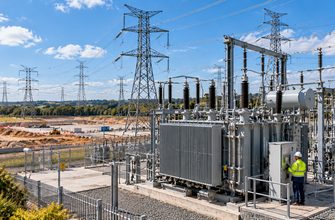
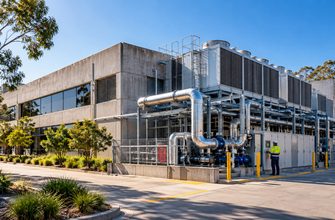
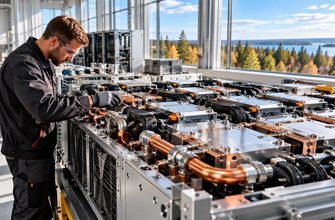
However, Aramco’s involvement does not automatically establish electricity supply arrangements for every future HUMAIN site. Large computing facilities still require suitable land, grid access, electrical equipment, cooling systems, networking and installed servers.
Power availability is already a strategic issue for the wider data-center industry. Norway’s energy regulator recently warned that data-center electricity demand could grow sharply under scenarios involving extensive development of grid-reserved projects.
The Saudi projects face their own engineering and commercial conditions, and no conclusion about their future energy costs or operational efficiency can be drawn from the ownership transaction alone.
What This Means for the AI Infrastructure Market
HUMAIN is pursuing a full-stack model combining physical data centers, cloud computing, advanced AI models and business applications. This differs from developers that focus only on constructing buildings or leasing electrical capacity.
The approach comes as AI companies increasingly seek long-term access to dedicated computing resources. Anthropic recently disclosed approximately $269.4 billion in multi-year cloud compute commitments across major technology providers, highlighting the scale of demand that infrastructure suppliers hope to serve.
For HUMAIN, the central execution questions remain how quickly planned capacity can be commissioned, which customers will contract for that capacity, and what computing hardware will ultimately be installed.
What Happens Next?
The next meaningful milestones are physical and commercial rather than financial headlines alone.
- Construction: measurable progress toward commissioning capacity at Oxagon and other announced sites.
- Customer agreements: conversion of preliminary capacity frameworks into definitive commercial arrangements.
- Infrastructure delivery: confirmed power connections, cooling systems, server installation and operational schedules.
- Financial disclosure: additional details on how the contributed assets and cash support HUMAIN’s expansion program.
Aramco’s entry as a 49% shareholder gives HUMAIN a new ownership and investment structure. Whether that translates into a globally competitive AI computing platform will depend on the delivery of actual megawatts, operational infrastructure and customers—not the 3GW target alone.