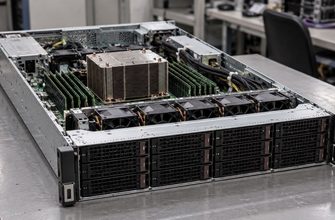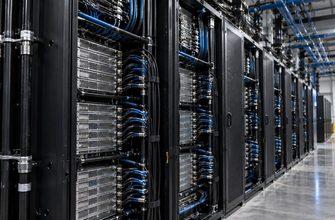
NVIDIA Vera Rubin rack designs are being opened to the server industry through the Open Compute Project (OCP). On October 12, 2026, NVIDIA announced that it had contributed key rack and compute-tray designs at the OCP Global Summit in San Jose, California, introducing an updated MGX 1.2 architecture that supports AI rack deployments of up to 250 kilowatts.
The announcement gives server manufacturers a common design foundation for building high-density AI infrastructure, including standardized liquid-cooling interfaces, power distribution and modular compute trays. The move addresses a growing challenge for data-center operators: deploying increasingly powerful AI systems without requiring every manufacturer to develop an entirely different physical infrastructure platform.
NVIDIA’s MGX 1.2 reference architecture supports high-density AI racks with liquid cooling, standardized power interfaces and modular hardware designs. The figure represents supported rack capacity, not a confirmed operating power draw for every Vera Rubin configuration.
What NVIDIA Is Opening to the Server Industry
The central development is NVIDIA’s contribution of Vera Rubin rack and compute-tray designs to OCP through its MGX architecture.
According to the official NVIDIA announcement, the updated specification includes rack-scale blind-mate liquid cooling, interoperable connections, configurable I/O bays and a liquid-cooled 5,000-ampere busbar designed for high-power systems.
MGX 1.2 also introduces native support for 19-inch equipment, fanless liquid-cooled compute trays and standardized interfaces intended to simplify manufacturing, installation and servicing.
The approach allows participating manufacturers to build systems around shared mechanical and infrastructure requirements rather than treating each AI server generation as a completely separate rack design.
Why 250kW AI Racks Change the Infrastructure Problem
A rack capable of supporting 250 kilowatts places substantial demands on a data center’s electrical distribution and cooling systems.
At this level of power density, conventional approaches to rack-level cooling, cabling and equipment servicing become increasingly difficult to scale. Liquid cooling can remove heat directly from major computing components, but it also introduces requirements for coolant distribution, connection reliability, maintenance procedures and leak management.
NVIDIA’s updated design uses blind-mate cooling connections, allowing compatible compute trays to connect to rack infrastructure as they are installed. Standardized interfaces may reduce manual connection work and help manufacturers establish more repeatable assembly processes.
However, support for 250kW racks does not establish that every data center can immediately deploy them. Facility-level electrical capacity, cooling systems and operational procedures must still support the chosen configuration.
Independent reporting from SiliconANGLE confirms that NVIDIA’s contribution focuses on common physical designs for computing, networking, power and cooling.
What Open NVIDIA Vera Rubin Rack Designs Actually Mean
The decision to contribute NVIDIA Vera Rubin rack designs to OCP should not be confused with making NVIDIA’s GPU architecture open source.
The contribution concerns the physical infrastructure surrounding accelerated computing systems: rack layouts, compute trays, power connections, cooling interfaces and related mechanical designs.
These shared specifications are intended to make compatible systems easier for hardware manufacturers and infrastructure operators to develop. They do not automatically guarantee that components from every supplier will be interchangeable or that systems will become available on identical schedules.
The distinction matters because deploying AI infrastructure involves more than obtaining GPUs. Operators must coordinate physical equipment, power distribution, cooling, networking and maintenance across potentially thousands of racks.
How the Announcement Fits Into the Open AI Hardware Push
NVIDIA’s announcement follows a broader industry effort to develop common reference architectures for large-scale AI computing.
On the same day, AMD unveiled its Helion rack platform, which can accommodate up to 32,768 EPYC CPU cores in a CPU-focused configuration. Servers.News previously covered AMD’s Helion AI server rack announcement and its planned partner availability in November 2026.
The two developments address different infrastructure requirements, but both demonstrate how server manufacturers are increasingly using open specifications to support specialized AI workloads.
NVIDIA’s contribution also builds on an installed infrastructure base. In September, CoreWeave disclosed a seven-rack Vera Rubin deployment spanning two regions, illustrating the operational complexity involved in managing multiple liquid-cooled AI systems.
The new OCP contribution is a separate development: it focuses on making rack-level design specifications available to the wider hardware ecosystem rather than announcing another customer deployment.
What Happens Next for Server Manufacturers?
The immediate next step is for OCP participants and NVIDIA’s manufacturing partners to incorporate the contributed designs into their hardware development and validation processes.
For data-center operators, the most important questions will be whether compatible components simplify deployment, reduce integration effort and improve maintainability under sustained production workloads.
The updated specification provides a technical foundation, but NVIDIA has not established a universal delivery schedule, price or independently verified operational savings for every system built around MGX 1.2.
NVIDIA Vera Rubin rack designs are now part of a broader effort to standardize the physical infrastructure needed for increasingly dense AI computing. The real test will be how effectively manufacturers turn those specifications into interoperable, serviceable systems that data centers can deploy at scale.
Reporting based on NVIDIA’s October 12, 2026, Open Compute Project announcement and independent coverage by SiliconANGLE. Technical specifications describe published architectural capabilities and should not be interpreted as measured performance across all commercial deployments.