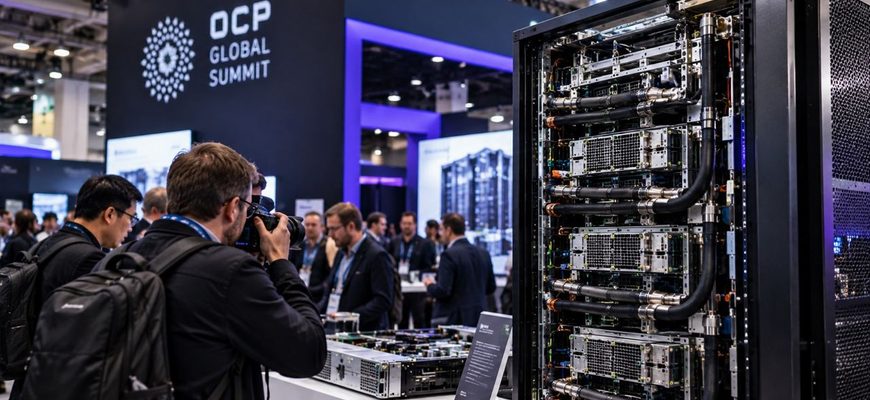
AMD Helion AI Rack is AMD’s latest answer to a problem that GPUs alone cannot solve. Unveiled at the 2026 Open Compute Project Global Summit in San Jose on October 12, the new rack-scale design can accommodate up to 32,768 AMD EPYC CPU cores, with alternative configurations combining CPUs and Instinct GPUs for enterprise AI workloads.
AMD expects its partners to make Helion configurations available in November 2026. For now, this is an open reference design under development, not a fully deployed commercial platform. Its main selling point is flexibility: operators can dedicate a rack to running AI agents or combine agent execution and model inference within the same system.
- Why AMD Is Building an AI Rack Around CPUs
- Two Helion Configurations for Different AI Workloads
- Inside the AMD Helion AI Rack
- Why the Mixed CPU and GPU Design Matters
- Open Standards Could Give Server Vendors More Flexibility
- Power and Cooling Will Shape Real Deployments
- What Is Still Unknown About Helion?
- November 2026 Is the Next Milestone
- The Real Test Comes After the Announcement
Why AMD Is Building an AI Rack Around CPUs
The 32,768-core figure is striking, but the thinking behind Helion is more interesting than the number. AI agents do considerably more than generate text. They execute code, interact with databases, move files and coordinate tasks across software systems. Those operations can place substantial demands on conventional processors even when a GPU handles the model inference.
AMD is designing Helion around that division of labor. A hyperscaler with separate GPU clusters can dedicate CPU racks to agent execution and orchestration. An enterprise without that infrastructure can put both types of computing in one rack.
That distinction matters because the fastest inference accelerator is not necessarily the best place to run every operation surrounding an AI model.
Two Helion Configurations for Different AI Workloads
AMD has outlined two principal configurations. Both use sixth-generation EPYC processors, but they address different deployment requirements.
| Feature | CPU-Only Rack | Enterprise CPU + GPU |
|---|---|---|
| Primary audience | Hyperscalers and large AI operators | Enterprise AI deployments |
| Processor platform | 6th Gen AMD EPYC | 6th Gen AMD EPYC |
| CPU capacity | Up to 32,768 cores | Varies with CPU and GPU blade mix |
| GPU acceleration | External inference infrastructure | Up to 16 AMD Instinct MI350P GPUs |
| Primary workload | Agent execution and orchestration | Agent execution and local inference |
| Cooling options | Air or liquid | Air or liquid |
| Deployment model | Disaggregated compute | Integrated compute platform |
The maximum CPU-core and GPU counts refer to different configuration options and should not be interpreted as simultaneous specifications for one fully populated rack.
The enterprise version uses Instinct MI350P accelerators for model inference. According to AMD’s published Helion specifications , a 5U GPU server contains eight MI350P accelerators. Two such servers can be installed in a rack. The GPU nodes operate independently rather than as one unified scale-up GPU domain.
Inside the AMD Helion AI Rack
Helion follows the Open Rack v3 specification and uses a 21-inch, 44OU rack design. AMD lists up to 102 Tbps of networking bandwidth, alongside configurable CPU blades and optional GPU inference servers.
The CPU options are particularly revealing. Instead of assuming every agent needs the same processor configuration, AMD is offering different choices for core density and frequency.
| Component | AMD Specification |
|---|---|
| Rack format | 21-inch OCP ORv3, 44OU |
| CPU architecture | AMD EPYC 9006, Zen 6 |
| Maximum CPU cores | 32,768 — CPU-only configuration |
| Dense CPU option | 256 cores, 400 W |
| Balanced CPU option | 256 cores, 600 W |
| High-frequency CPU option | 96 cores, up to 5.0 GHz |
| GPU option | Up to 16 AMD Instinct MI350P accelerators |
| GPU node configuration | 8 GPUs per 5U server |
| Networking bandwidth | Up to 102 Tbps |
| Cooling | Air and direct liquid cooling |
| Architecture | Open Compute Project standards |
| Partner availability | Targeted for November 2026 |
Figures represent AMD’s published design specifications and configuration limits. Actual rack specifications will depend on the system assembled by each partner.
Why the Mixed CPU and GPU Design Matters
In an agent-driven application, the workload can move repeatedly between a language model and the software performing the requested work. An agent might ask a model to plan a task, execute a script, inspect the result and return to the model for another decision.
AMD’s design gives infrastructure operators a way to assign those different operations to appropriate hardware. Helion also includes an integrated token-routing capability designed to direct model requests between frontier and open-source models.
That does not make the GPU optional for every AI application. It means operators have more freedom to decide where inference takes place and how much CPU capacity they allocate to everything around it.
The enterprise configuration is also distinct from AMD’s Helios platform. Helios is built for large-scale training and inference using a unified GPU architecture. Helion is designed around agent execution, with GPU capacity added where the workload requires it.
Open Standards Could Give Server Vendors More Flexibility
Another important part of the announcement is AMD’s decision to use an open reference architecture rather than a single fixed rack configuration.
The design draws on Open Compute Project standards for rack infrastructure, management, networking and power distribution. AMD plans to contribute the Helion specification to OCP for further development and adoption.
Cisco, Dell, HPE, Lenovo, Supermicro, QCT, Foxconn and Wiwynn are among the companies supporting the initiative.
For server manufacturers, a common blueprint can reduce the amount of system design that must be repeated for each customer. For buyers, it creates the possibility of configurations tailored to different AI workloads and data center environments.
Those advantages are still prospective. Neither the number of supporting companies nor the openness of the design establishes how quickly production systems will ship.
Power and Cooling Will Shape Real Deployments
A rack containing thousands of CPU cores presents its own infrastructure challenges. The power requirements depend on which CPU blades are installed, how densely the rack is populated and whether GPU acceleration is included.
AMD supports both air-cooled and direct liquid-cooled configurations, giving partners room to adapt Helion to different facilities. The company has not published one universal power-consumption figure for every possible rack configuration.
That flexibility is particularly relevant to operators working within existing power and cooling limits. A highly dense rack is not automatically the most economical choice if the facility requires substantial upgrades to accommodate it.
Servers.News previously examined AMD’s rack-scale AI energy-efficiency strategy , including the growing importance of power consumption and system-level design. Helion takes a different approach to that same infrastructure challenge by allowing operators to adjust CPU density and GPU capacity to their workloads.
What Is Still Unknown About Helion?
AMD has disclosed a detailed architectural blueprint, but several commercial questions remain unanswered.
The company has not announced universal system pricing, confirmed production shipment volumes or published independently verified performance results for complete Helion deployments.
It is also too early to establish how the proposed rack designs will compare with competing systems in real-world cost per agent, performance per watt or operational complexity.
Those measurements will matter more to infrastructure buyers than the headline CPU-core count alone.
November 2026 Is the Next Milestone
AMD says Helion rack configurations remain under development with its ecosystem partners, with availability currently planned for November 2026.
The company has also committed to contributing its design specification to the Open Compute Project, although a precise submission date has not been announced.
Independent reporting from Data Center Dynamics and The Register confirms the announcement and AMD’s planned availability window.
The Real Test Comes After the Announcement
AMD Helion gives CPU infrastructure a more prominent role in the AI server discussion. The headline specification is 32,768 EPYC cores per rack, but the more practical idea is the ability to build different systems for different kinds of agent workloads.
Whether that approach succeeds will depend on the systems AMD’s partners deliver: their actual power requirements, operational performance, cost and integration with existing infrastructure.
For now, the official October 12 announcement establishes a concrete new rack design. The next step is seeing those specifications turn into hardware that customers can evaluate and deploy.