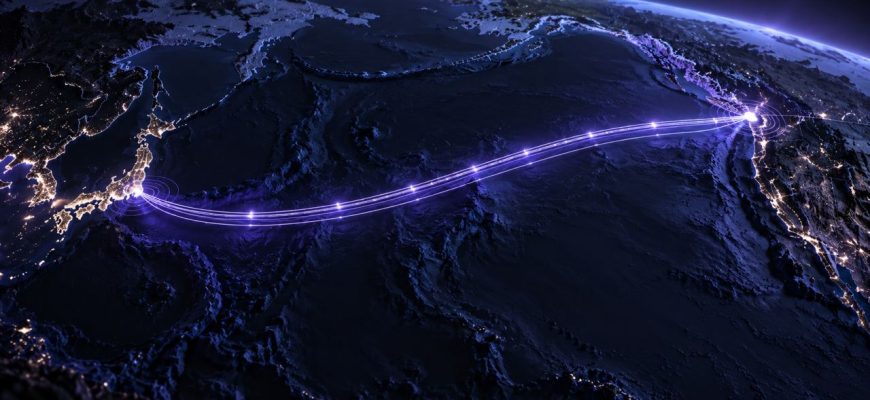
Amazon Web Services is developing a new 420 Tbps subsea cable between Washington state and Japan, creating a geographically distinct transpacific route that is expected to enter service in 2029.
The cable, named Sta’O’Nuk, will carry its designed capacity across 20 fiber pairs and become part of the AWS Global Network. AWS announced the project on September 2, positioning the new route as both a capacity expansion and a way to reduce dependence on the established cable corridors that concentrate transpacific landings in California and Oregon.
The project extends AWS infrastructure beyond data centers and terrestrial fiber into another layer of the physical network connecting its regions and workloads. AWS says the cable is intended to support bandwidth-intensive traffic including distributed AI training, financial transactions, edge applications and video delivery.
A New Route Into Washington State
The landing geography is a central part of the project. AWS says more than 30 transpacific subsea cables already operate across the region, with U.S. landing infrastructure heavily concentrated along California and Oregon and major Japanese gateways concentrated around Shima and the Chiba Peninsula.
Sta’O’Nuk will instead use a new landing point in Washington state and a geographically diverse landing point in Japan. AWS says it will be the first international subsea cable system to land in Washington in almost 30 years.
That diversity matters because multiple cables sharing the same coastal corridors can also share exposure to earthquakes, ship anchors, fishing activity and other physical disruptions. A separate Washington route gives AWS another path for traffic between North America and Asia-Pacific rather than simply adding capacity to an existing corridor.
On the U.S. side, AWS is working with Toptana Technologies, an Indigenous-owned cable landing station and backhaul network venture of the Quinault Indian Nation. Toptana is developing the Washington landing infrastructure, while Assured Communications is supporting the project as a strategic partner, program manager and operations service provider.
Sta’O’Nuk Will Join AWS’s Private Global Network
AWS plans to integrate Sta’O’Nuk directly into its global network, which the company says currently spans more than 20 million kilometers of fiber across 39 Regions, 124 Availability Zones, 46 Local Zones and more than 750 Points of Presence.
The cable is designed with flexibility for additional connection points, giving AWS the option to extend connectivity or add capacity to other locations as demand develops. The company has not disclosed the precise Japanese landing location in its announcement.
Physical Protection and Multi-Layer Encryption
AWS also disclosed unusually specific security and physical-protection plans for the system. Traffic is intended to use what AWS describes as quantum-safe optical encryption at Layer 1, MACsec at Layer 2, and TLS/SSL or QUIC at higher layers.
Physical protection will include armored cable and burial in vulnerable areas at water depths of up to 1,500 meters. AWS also plans to use horizontal directional drilling around landing zones, routing the cable beneath beaches, dunes and shallow seabeds rather than disturbing the surface shoreline.
The design reflects the operational problem Sta’O’Nuk is intended to address. AWS says roughly 200 subsea cable cuts occur worldwide each year, with fishing activity and dragged anchors responsible for many incidents. Geographic separation cannot eliminate cable failures, but it can reduce the risk that a single regional event affects several network paths at once.
The Network Layer Is Expanding With AI Compute
The 420 Tbps project arrives as hyperscalers expand not only AI data-center capacity but also the networks required to move data between geographically distributed compute infrastructure. Large training and inference deployments can increase demand for high-throughput connections between regions, while cloud operators also need redundant paths for conventional workloads.
For infrastructure teams, the important part of Sta’O’Nuk is therefore not simply its headline capacity. The project adds a new physical Pacific route, a new Washington landing point and another AWS-controlled path into the Asia-Pacific network.
The next milestones are construction and installation progress, disclosure of the Japanese landing location, and confirmation of the system’s ready-for-service date. Until then, the 420 Tbps figure and 2029 launch remain planned specifications rather than operational capacity.