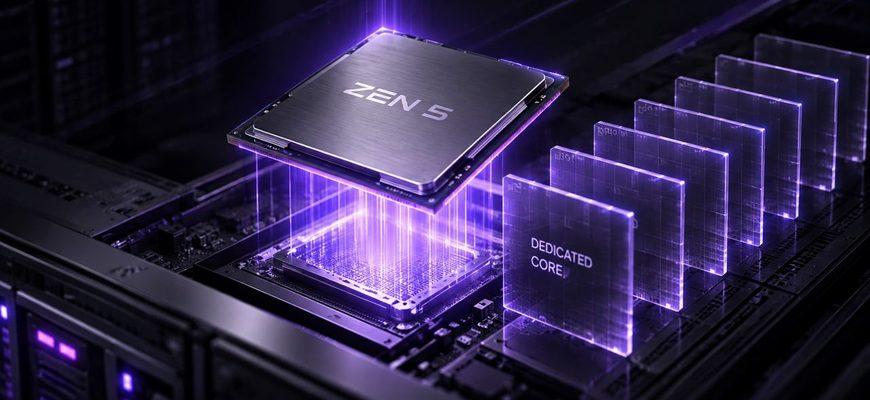
VPSLab has launched a new virtual server line based on AMD’s Ryzen 9 9950X processor, pairing dedicated Zen 5 CPU cores with DDR5 ECC memory, PCIe 4.0 NVMe storage and 10 Gbit/s networking.
The service, announced on September 4, targets performance-sensitive workloads that can suffer when virtual CPUs compete for processor time on oversubscribed hosts. VPSLab says cores assigned to the new instances are pinned through KVM rather than drawn from a shared vCPU pool.
The launch puts predictable CPU allocation at the center of the product rather than simply increasing the number of virtual cores. That distinction is particularly relevant for databases, build systems, game servers and other workloads that can sustain high CPU utilization for extended periods.
Ryzen 9 9950X Becomes the Host Platform
All four configurations in the new range use AMD’s Ryzen 9 9950X, a 16-core, 32-thread Zen 5 processor with boost frequencies of up to 5.7 GHz. VPSLab combines the processor with DDR5 ECC memory and local NVMe Gen4 storage.
The provider says its storage layer uses enterprise PCIe 4.0 NVMe drives in local RAID and advertises sequential read performance of roughly 7 GB/s. That figure is a vendor specification rather than an independently verified benchmark.
Network access is provided through a 10 Gbit/s port across the range. Included monthly traffic scales from 10 TB on the smallest configuration to 50 TB on the largest. VPSLab says connections are rate-limited after the allowance is exhausted rather than generating bandwidth overage charges.
Four Dedicated-Core Configurations
| Plan | vCores | Memory | NVMe | Traffic |
|---|---|---|---|---|
| R9 Start | 2 | 6 GB DDR5 ECC | 30 GB | 10 TB |
| R9 Boost | 4 | 12 GB DDR5 ECC | 50 GB | 20 TB |
| R9 Apex | 8 | 24 GB DDR5 ECC | 80 GB | 35 TB |
| R9 Ultra | 12 | 48 GB DDR5 ECC | 120 GB | 50 TB |
The four plans use the same processor generation, memory technology, storage platform and network port. The primary differences are therefore the amount of allocated compute, memory, storage and monthly traffic.
Why Dedicated CPU Allocation Matters
Shared-vCPU infrastructure remains useful for workloads with intermittent compute demand because providers can distribute physical CPU capacity across multiple virtual machines. The trade-off is that sustained performance can depend on host utilization and scheduler contention.
Pinning cores changes that resource model. A virtual machine receives CPU resources that are not simultaneously allocated to other tenants, making sustained compute performance more predictable.
That does not make a virtual server equivalent to a dedicated physical machine: storage, networking and other host infrastructure can still be shared. But CPU isolation can remove one of the main sources of performance variability for applications running continuously under load.
VPSLab lists game servers, CI/CD workloads, databases and other latency-sensitive applications among the intended uses for the new platform.
Dedicated Resources Are Becoming a Clearer VPS Tier
The launch comes as hosting companies increasingly separate general-purpose virtual machines from configurations designed around predictable compute resources.
Contabo, for example, reorganized its VPS portfolio in August into Core, Performance and Max Performance tiers. Its highest virtual-server tier, previously marketed as VDS, is positioned around dedicated CPU and memory resources, while its Performance range uses AMD EPYC processors and NVMe storage for workloads including databases and CI/CD.
The two implementations are not directly comparable, but the product segmentation points to a broader distinction emerging in virtual hosting: the number of advertised vCPUs alone provides less information than how those CPU resources are actually scheduled and shared.
What Happens Next
The new Ryzen instances are already listed by VPSLab as available configurations. The key question for infrastructure operators will be whether dedicated-core VPS products can deliver sufficiently consistent performance to justify their higher resource commitment compared with conventional shared-vCPU instances.
For buyers evaluating this class of server, CPU allocation policy is therefore becoming a specification worth examining alongside core count, memory, NVMe capacity and network bandwidth.